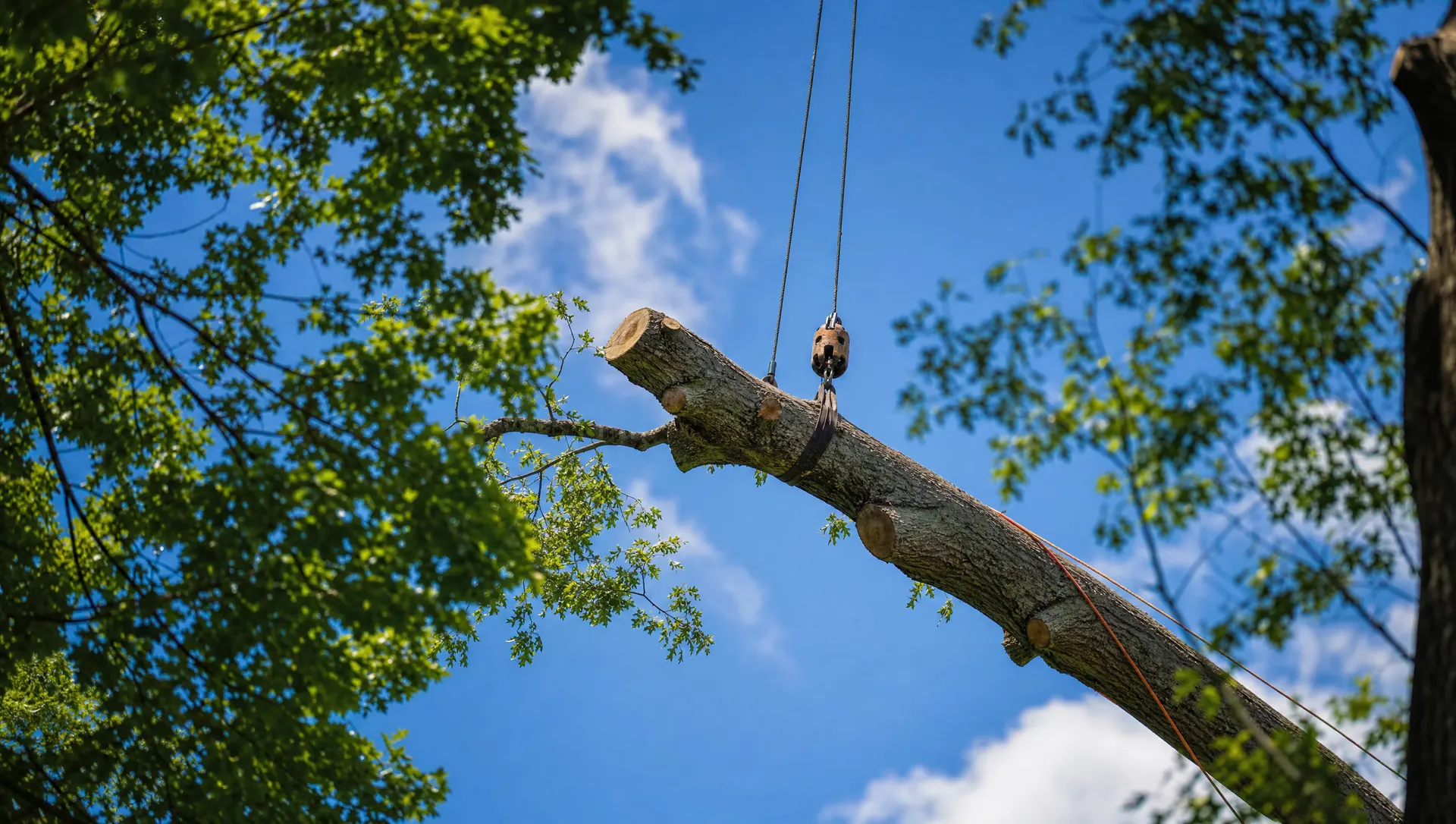
Emergency Storm Damage in St. Peters, Missouri
A storm doesn't ask permission before it takes a limb off a silver maple and drops it across the driveway, or splits a pin oak down the middle and leaves half of it resting on the roof. When that happens, the first question isn't cost — it's what's safe to go near and what needs to come down before anything else happens. St. Peters Tree Removal connects homeowners across St. Peters and St. Charles County with local crews for storm-damaged tree cleanup — downed limbs, split trunks, trees leaning on structures, and everything a bad storm leaves behind.
If a line is involved, stop reading and get everyone clear of it first. Otherwise, tell us what the storm left behind and we'll get that request to a crew.
What Counts as Storm Damage
Storm calls come in more shapes than a routine removal:
- Limbs down — broken branches hanging in the canopy or scattered across the yard, driveway, or roof
- Split or broken trunks — a tree cracked partway through that's still standing but structurally compromised
- Full trees down — uprooted or snapped trees lying across a fence, driveway, deck, or yard
- Trees leaning on the house — a tree pushed off-vertical by wind and now resting against or hanging over a structure
- Root-heaved trees — a tree still upright but with the root ball partially lifted out of the ground, which makes it unstable even though it looks intact
Each of these needs a different first move, which is why describing exactly what you're looking at — leaning, split, fully down, resting on something — matters more for storm calls than for routine work.
Power Lines Change Everything
If a downed limb or tree is touching a power line, treat the whole area as live and stay back — the ground around it, standing water nearby, even a chain-link fence the line is resting on can carry current. Tree crews do not clear lines that are still energized; that work belongs to the utility. In the St. Peters area, that's Ameren — call them first if a line is involved, before calling anyone else. Once the utility has addressed the line, we can handle everything else: the tree, the limbs, and the cleanup.
St. Charles County's Storm Pattern
Straight-line wind events move through this part of the Midwest fast — a storm line can cross St. Charles County in under half an hour and leave one subdivision covered in downed limbs while a mile away nothing happened. The established neighborhoods off Mid Rivers Mall Drive and similar 1980s and 1990s subdivisions got their trees planted the same year the houses went up, which means whole streets of same-age, same-species trees tend to fail together in the same event — if one silver maple on the block came down, it's worth checking the yard carefully, because the tree three doors down grew up under the same conditions.
After a widespread storm, the practical reality is that everyone on the street is calling at once. Getting your situation described clearly and completely — what's down, what's leaning, what it's resting on — helps get the work planned and scheduled without back-and-forth.
When to Call
Reach out any time a storm leaves a tree, limb, or root system compromised: something down across the driveway or a fence, a crack running down a trunk, a tree noticeably more off-vertical than it was before the storm, or a limb hung up in the canopy instead of on the ground. A hung-up limb — sometimes called a widow-maker — is often more dangerous than one already down, because it can fall with no additional wind or warning at all.
What Storm Cleanup Typically Costs
Storm work varies more than routine removal because the damage itself varies:
- A single downed limb with easy access typically costs the least — often comparable to a small trim job
- A full tree down across a yard typically costs more, largely driven by size and whether it's resting on anything
- A tree leaning on a structure typically costs more than either of the above, since it has to be rigged and lowered carefully rather than just cut and hauled
- Debris volume — a storm that brought down multiple trees or heavy limb loss across the yard adds to the cleanup time regardless of the removal itself
We give a real number once we see what the storm actually did — over-the-phone estimates for storm damage are rarely accurate given how much variation there is between one downed limb and a tree resting on a roofline.
Questions About Storm Damage
The tree isn't fully down, it's just leaning more than before. Is that urgent?
Often more urgent than a tree already on the ground, honestly. A tree that's leaning but still rooted can still be actively failing — the root system may be partially torn, and further wind or even its own weight can bring it down with little warning. Treat a new or worsening lean as something to address quickly, and keep people and pets away from the base and the direction it's leaning.
Do you handle the cleanup if the tree already fell on its own, not from a storm?
Yes — a tree doesn't have to fall in a named storm to need the same kind of response. Root failure, disease, or age can bring a tree down on a calm day, and the cleanup and hauling work is the same regardless of what caused it.
What if I'm not sure whether a line is involved?
Treat it as if it is until you can confirm otherwise from a safe distance. Downed lines aren't always obviously visible, especially tangled in branches or covered by leaves, and the consequence of being wrong is serious enough that caution costs nothing. If there's any doubt, keep clear and contact Ameren to check the line before anyone approaches the tree.
Get a Free Quote
If a storm left a tree, limb, or root system compromised on your property, tell us what happened and where — we'll get that in front of a local crew.
Need Help in St. Peters Right Now?
Tell us what you need and we'll get back to you fast with a free, no-pressure quote.